Guide / Buyer guides
Real or staged? How to tell if a robot in a video is controlled by a human
A robot that pours a drink, folds a shirt and chats with guests looks like the future arrived. Sometimes it has. Often a person in a VR headset is doing the hard part, or the clip is sped up, or it is the best of many attempts. None of that is fraud in itself. Teleoperation is how most robots learn. The problem starts when a video lets you believe the robot did it alone.
At a glance · reported claims
2-10x
Speed-up in a 2024 Optimus video, noted in a small corner label
200
Attempts behind one successful sorting clip cited by MIT Technology Review
1.2x
Time penalty for remote-controlled robots at the 2026 Beijing half marathon
300 g
What a 2,600 dollar vacuum arm can lift, a useful reality check
When it came out
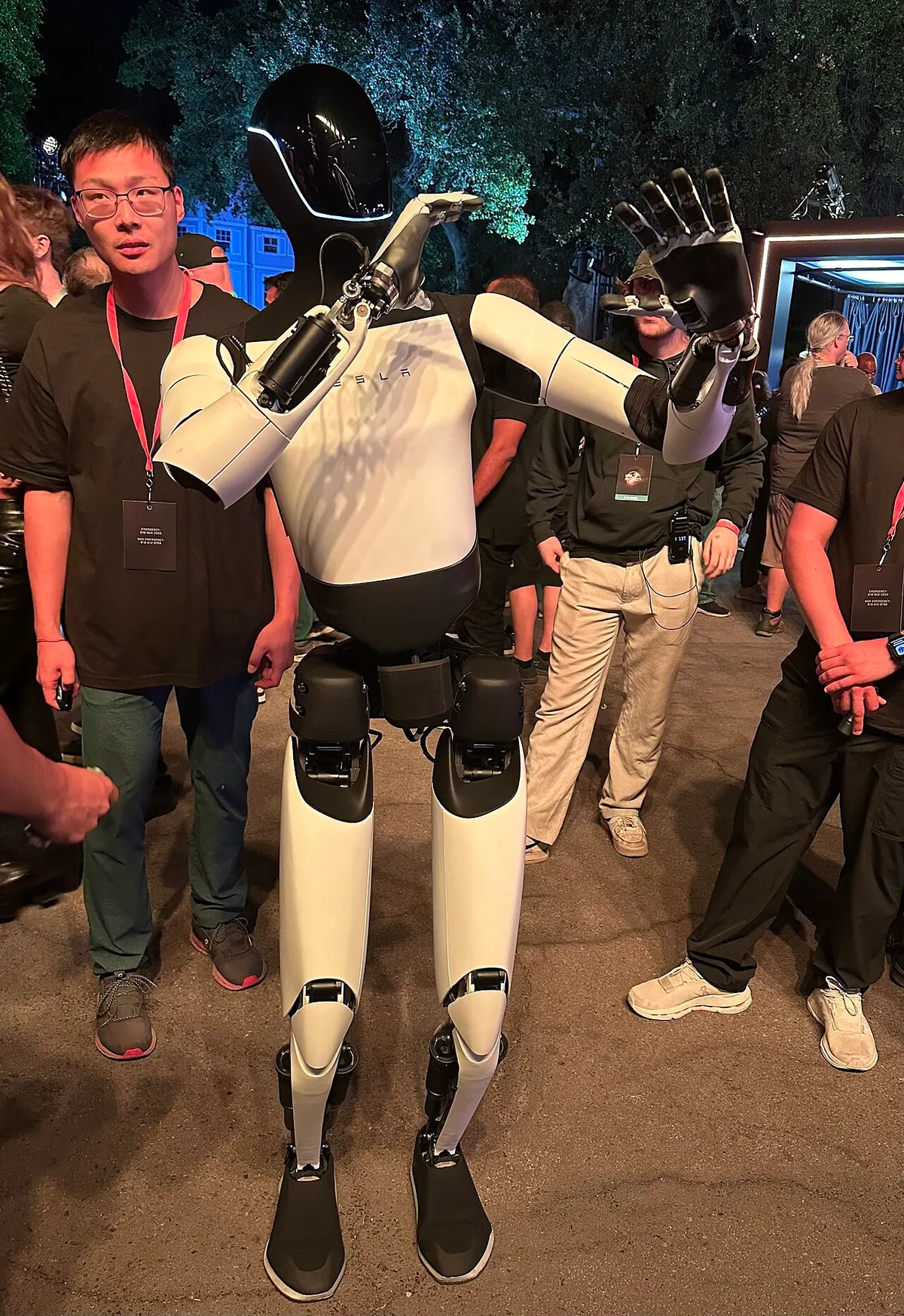
The best-known case came in October 2024 at Tesla's We, Robot event. Optimus robots walked among guests, poured drinks and chatted. Bloomberg, The Verge and others reported that remote employees controlled many of those interactions, Morgan Stanley analyst Adam Jonas wrote that the bots relied on human intervention, and one bartending robot told a guest it was assisted by a human. According to Bloomberg, the robots could walk without outside control.
A few days later Tesla released a clip of Optimus walking through a factory, carrying boxes and pouring drinks. Parts were sped up two to ten times, disclosed in a small label in the top right corner that is easy to miss. That is disclosure, but of a kind most viewers will not notice.
Honest labelling exists too. Stanford's Mobile ALOHA videos are described as a teleoperation system for data collection. Organisers of the April 2026 robot half marathon in Beijing multiplied remote-controlled robots' times by 1.2, openly separating them from autonomous ones. And when 1X launched NEO, the company itself explained that operators handle complex tasks at first.
Seven signs to watch for
IEEE Spectrum's robotics editor Evan Ackerman and Berkeley roboticist Ken Goldberg, writing in MIT Technology Review, have listed signs that should make you look twice. None proves fakery on its own, but together they work well.
First, a complex task with no pauses. An autonomous robot needs time to sense, decide and plan, so a long multistep job with fabric or several objects done without a single pause is probably human-driven. Second, movements that are too human: extra finger motions, returning an arm to a rest pose, slight sloppiness give away an operator, while autonomous robots tend to move more evenly. Third, legs or a hand in a sensor glove appearing at the edge of the frame. Not seeing an operator proves nothing.
Fourth, captions and context: read the description, project page, paper and credits. Fifth, speed: look for 2x, 4x or timelapse labels, including small print in a corner. Sixth, the setting: a clean empty hall is very different from a warehouse with people, stairs and slippery floors. Seventh, hands and weight. Goldberg says many humanoids would struggle to hold even a hammer at arm's length, and demo boxes are often squeezed from the sides by the shoulders and may well be empty.
Why teleoperation is not the enemy
Ackerman stresses that teleoperation itself is fine. Humans still beat robots at almost any complex manual task, and recordings of people guiding robots become training data. That is how Sanctuary AI and Stanford worked, and how 1X and Weave work now.
The problem is when an operated clip looks like autonomous work. Viewers get a false picture, and later even real progress gets misjudged. That is why the IEEE Robotics and Automation Society advises putting the context on the video itself, not only in a description that gets lost when clips are shared.
Checklist before you buy or sign
If you are choosing a robot for a business or home, do not stop at the video. Ask for a live demo on your site or a similar one, without preparation and with a task you pick. Ask directly whether the task runs autonomously, with assistance or fully by an operator.
Find out how many human interventions a shift needs and who makes them: your staff or the maker's remote operator. If it is a remote operator, ask where they are, what they see and whether it is recorded. Ask for numbers: success rate, time per operation, stops per day.
A good benchmark is AgiBot's 24-hour store test in Shanghai in November 2026: six robots, a public livestream, and two of them failed the assessment. A maker willing to show its failures is usually more honest than one that shows only the perfect take.
Robots in this guide
 USA
Bipedal humanoid
Bipedal humanoid (home)
Home chores robot
Wheeled humanoid
 China
Bipedal humanoid
Wheeled humanoid (Gen 8)
Frequently asked questions
+Is teleoperation cheating?
No. It is how most robots collect training data, and some products (1X NEO, Weave Isaac) openly rely on it. It becomes misleading only when a video implies the robot acted alone.
+Were Tesla's bartending robots controlled by people?
According to Bloomberg, The Verge and others, remote employees controlled many guest interactions at the October 2024 We, Robot event, and one robot said it was assisted by a human. Bloomberg's sources said the robots walked without outside control.
+What is the quickest check on a viral clip?
Look for a speed label (2x, 4x, timelapse), read the original post or project page, and ask whether a long, fiddly task runs without a single pause. If all three look too good, assume a human was involved until shown otherwise.
+Do home robots use remote operators?
Yes, openly. 1X NEO uses an Expert Mode with remote operators for tasks it cannot yet do alone, and Weave Isaac 1 brings in a Weave employee when its AI gets stuck. See our home robot guide for the privacy questions to ask.
Sources & editorial note
- MIT Technology Review · A skeptic's guide to humanoid-robot videos · 27 August 2024
- IEEE Spectrum · That awesome robot demo could have a human in the loop · 23 January 2024
- TechCrunch · Tesla Optimus bots were controlled by humans during the We, Robot event · 14 October 2024
- Futurism · Tesla sped up video of Optimus robots · 17 October 2024
- Beijing Municipal Government · Humanoid half marathon results · 19 April 2026
- Engadget · 1X Neo will learn chores via teleoperation · October 2025
- Interesting Engineering · Six AgiBot humanoid robots run Chinese store for 24 hours · November 2026
An original RoboHub summary and analysis based on the sources listed above. Figures and plans are attributed to the companies and media that published them; RoboHub has not independently tested the robots. This is not a sponsored article.