Guide / Buyer guides
Warehouse robots in 2026: types, prices, subscriptions and how to run a pilot
A warehouse rarely needs a robot. It needs a specific load to get from one point to another faster, cheaper or without people lifting it in a hot trailer. Start from what you move (a tote, a cart, a pallet, a box in a truck) and the robot type almost picks itself. This guide covers the five types, the price ranges that are actually published, how subscriptions work and how to set up a pilot that tells you something.
At a glance · reported claims
≈$21k
Light transport AMR Pudu T300 (dealer price)
$100-200k
Autonomous forklift per unit with integration (Grand View Research)
700/h
Cases per hour Stretch unloads from trucks, per DHL
19%/yr
Forecast mobile robot market growth to 2030 (Interact Analysis)
Five types, by what they move
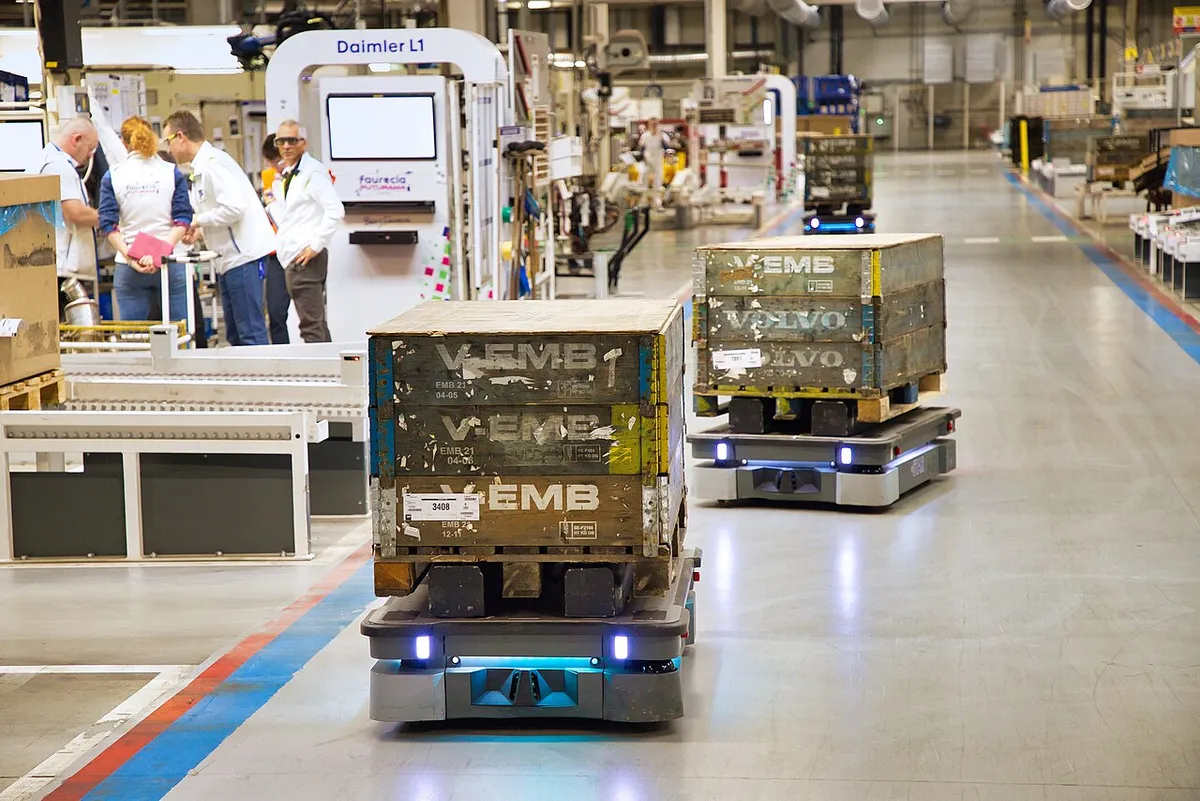
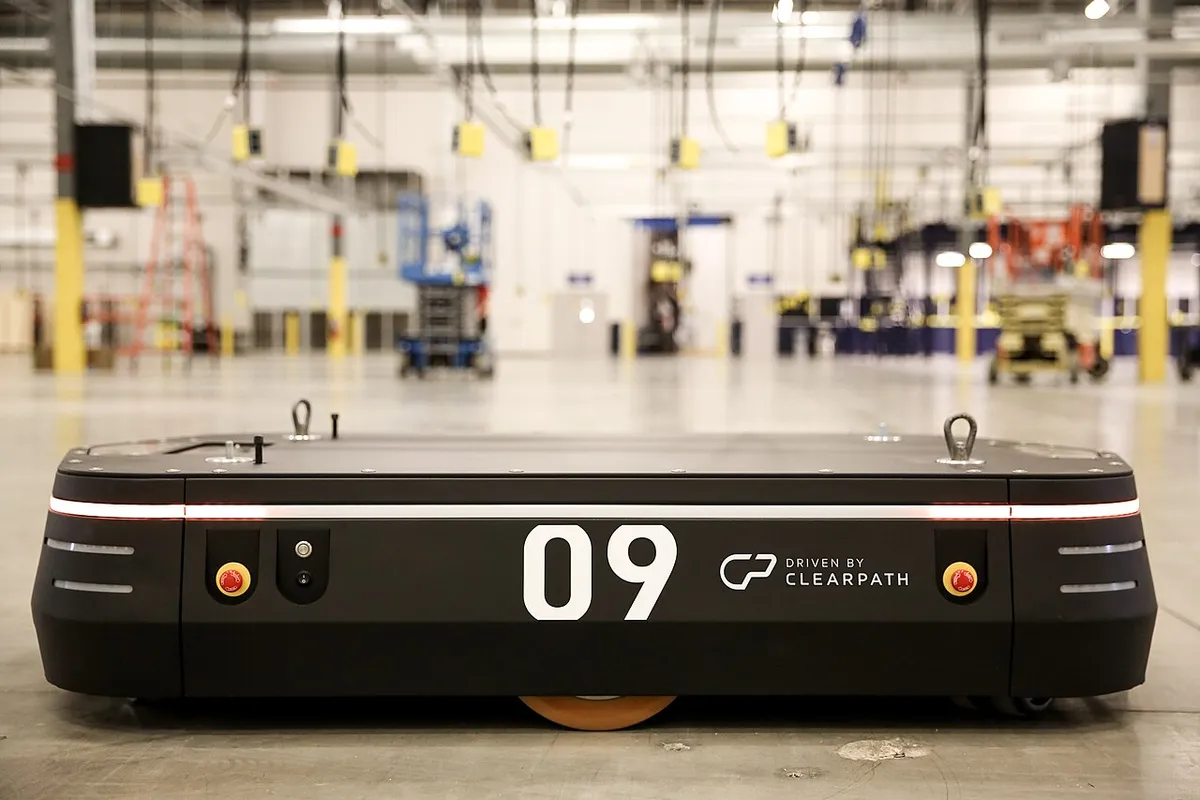
Transport AMRs move carts, totes and racks between zones: MiR250 and MiR600, OTTO 100 and OTTO 1500, Locus Vector, Pudu T300. They need no floor markers, build their own maps and steer around people. They fit if staff currently push carts from a line to storage or from receiving to racks.
Goods-to-person picking systems cut walking for pickers. Locus Origin drives to a worker with a tote, Geek+ lifts and brings a whole rack, and Exotec Skypod and Hai Robotics HaiPick climb the racks for bins. Here order lines per hour and storage height matter most.
Autonomous pallet trucks and forklifts take standard pallets on forks: Seegrid Palion, MiR1200 Pallet Jack, Vecna, Third Wave Automation, AGILOX ONE. This is the most expensive group; Interact Analysis expects forklifts to bring about a third of mobile robot revenue by 2030 while making up only 14% of units.
Truck and case unloaders such as Boston Dynamics Stretch and Dexterity Mech take on the heaviest job in a warehouse. DHL says Stretch unloads up to 700 cases an hour, and in 2025 it signed an MOU for 1,000 more. Then there are humanoids: Agility Digit has moved over 100,000 totes at a GXO site, but the new Digit 5 reaches customers only in 2027. For most warehouses a humanoid is a pilot today, not the main tool.
What it costs: the numbers that are actually public
Warehouse robotics is sold almost entirely by project, so few prices are public. The light transport AMR Pudu T300 costs about $21,000 at the dealer RobotLAB. An autonomous forklift costs $100,000-200,000 per unit according to Grand View Research, as cited by DC Velocity in October 2026; that covers hardware, software and integration, and sometimes site mapping, training and maintenance.
Industry overviews give a range of roughly $25,000 to $150,000 per transport AMR and $2,000 to $8,000 per robot per month for subscriptions. Those overviews do not name sources for the figures, so treat them as rough orientation, not as a budget.
Beyond the robots, a budget almost always includes integration with your WMS or ERP, floor and Wi-Fi preparation, mapping, staff training and yearly maintenance. Rocrich sales director Brian Markison says per-unit cost falls as the fleet grows, because fixed project costs are spread across more machines. That is why a two- or three-robot pilot nearly always costs more per robot than a full rollout.
Buying versus subscription (RaaS)
Many warehouse robot vendors sell a subscription instead of a purchase. Locus Robotics, for example, charges per robot per year, billed in advance, plus a small one-time setup fee per site that covers solution design, servers, Wi-Fi and training. The subscription includes LocusONE software, 24/7 support, maintenance and upgrades. The company says payback typically comes within 12 months, but that is a vendor claim.
A subscription suits operations with strong seasonal peaks: add robots for the high season and return them afterwards. Buying pays off with steady load for years ahead. Our guide on buying, leasing and subscriptions compares them over three years, and the ROI calculator gives a quick payback estimate.
Readiness and vendor risk
According to DC Velocity, the main barriers for autonomous forklifts are upfront cost, integration with legacy WMS and a warehouse that is not ready: no consistent processes and no system that splits work between robots and people. If your routes are changed by hand every day, sort out the processes first; a robot will not do it for you.
The second risk is the vendor. Seegrid's chief sales officer David Griffin estimates that more than 80% of automation-only startups will not survive as standalone companies. That comes from a competitor, but the question is fair: who will service the robots in five years? Ask how many units are deployed, how long support lasts, how spare parts are supplied and what happens to the software if the company is sold or closes. For reference, Seegrid reports more than 2,500 robots at over 50 customers, and Linde more than 1,500 autonomous units sold.
How to run a pilot that tells you something
Most projects start with a pilot of a few machines, and that is the right call. Before you start, record baseline numbers without robots: lines or pallets per hour, metres walked per worker per shift, how many people work on this step. Without that, there is nothing to compare against three months later.
During the pilot track four things: throughput per hour, the share of time the robot is actually working, human interventions per shift, and how much staff time the robots take. Ask the vendor to set out in the contract how the fleet scales after the pilot, at what price, and whether you can exit if targets are not met.
Robots in this guide
Industrial delivery AMR
 Denmark
Compact AMR
 Canada
Heavy-payload AMR
Collaborative order-picking AMR
Shelf/pallet lifting goods-to-person AMR
Autonomous pallet truck
Mobile manipulator for truck unloading and palletizing
Bipedal humanoid (warehouse)
Frequently asked questions
+How much does a warehouse robot cost?
Published examples: about $21,000 for a light transport AMR (Pudu T300, dealer price) and $100,000-200,000 per autonomous forklift with integration (Grand View Research). Most systems are quoted per project, and integration, mapping, training and maintenance add to the robot price.
+AMR or autonomous forklift?
Look at what your load sits on today. Carts, totes and racks suit AMRs such as MiR, OTTO or Locus; standard pallets need a pallet truck or forklift such as Seegrid Palion or MiR1200 Pallet Jack.
+Can I rent warehouse robots?
Yes, many vendors offer subscriptions. Locus charges per robot per year with a one-time site setup fee and includes software, support and maintenance; AGILOX offers rentals; Yale offers forklift automation for a single monthly fee.
+Are humanoids ready for warehouses?
For pilots, yes; for most fleets, not yet. Agility Digit has moved over 100,000 totes at GXO, but Digit 5 reaches customers only in 2027, and no warehouse humanoid has a public price. Wheeled AMRs and forklifts remain the proven option.
Sources & editorial note
- DC Velocity · Automated forklifts: hot or not? · 19 October 2026
- DHL Group · MOU with Boston Dynamics for 1,000 additional robots · 13 May 2025
- Robotics 24/7 · Interact Analysis: mobile robots market grows 19% a year to 2030 · 15 January 2026
- Locus Robotics · Robots-as-a-Service (vendor page)
- PickTheRobot · Warehouse robot cost 2026 (industry overview, sources not named)
- OODA Loop · Agility Digit passes 100,000 totes at GXO · June 2026
An original RoboHub summary and analysis based on the sources listed above. Figures and plans are attributed to the companies and media that published them; RoboHub has not independently tested the robots. This is not a sponsored article.